Most Ottawa pool owners know they should test their water, but few know exactly which parameters to check, how often each one needs testing, or what the target ranges are for a healthy pool. That knowledge gap has real consequences. Poor water chemistry doesn’t just make swimming uncomfortable, it bleaches and ages your liner, corrodes your equipment, wastes chemicals, and shortens the life of every component in your system.
This guide closes that gap. By the end, you’ll know exactly what to test for, how often to test each parameter, which testing method fits your situation, and when to bring a sample in for a professional analysis. Regular swimming pool chemical testing is the single most important diagnostic habit for keeping your pool healthy, and it’s easier than most owners think.
Quick Answer: What Should You Test and How Often?
Ottawa pool owners should test six key parameters: free chlorine, pH, total alkalinity, calcium hardness, cyanuric acid (stabilizer), and metals (iron and copper). Free chlorine and pH need weekly testing during swim season, and more often during heavy use or heat waves. Alkalinity gets tested every two weeks. Calcium hardness, stabilizer, and metals need monthly testing. A professional water analysis at opening, mid-season, and closing gives you the most accurate baseline.
| Parameter | Target Range | DIY Test Frequency | Professional Test |
|---|---|---|---|
| Free chlorine | 1.0 to 3.0 ppm | Weekly (2x in heat) | Every visit |
| pH | 7.2 to 7.6 | Weekly | Every visit |
| Total alkalinity | 80 to 150 ppm | Every 2 weeks | Monthly |
| Calcium hardness | 150 to 280 ppm | Monthly | Monthly |
| Cyanuric acid | 30 to 50 ppm | Monthly | Monthly |
| Metals (Fe/Cu) | Below 0.1 ppm | As needed | At opening |
These target ranges come directly from ML Pool Services’ own published chemistry standards, so you’re working from local, proven numbers.
Why Water Testing Matters (Beyond Clear Water)
Testing is about far more than aesthetics. Balanced water protects your liner from bleaching, staining, and premature wear, while unbalanced pH quietly corrodes your pumps, heater components, and metal fittings. Off-target chemistry also burns through chlorine, wasting money every week.
Most importantly, testing is the diagnostic step that catches problems before they become expensive. An undetected imbalance leads to algae, calcium scale, and equipment damage that costs far more to fix than the few minutes testing takes. Protecting a vinyl pool liner alone makes consistent testing worthwhile, since liner replacement is one of the costliest repairs a pool owner faces.
The Six Key Parameters Every Ottawa Pool Owner Should Test
Here’s each parameter, its target range, why it matters, how often to test it, and the Ottawa-specific context that shapes it.
Free chlorine (1.0 to 3.0 ppm)
Free chlorine is the active sanitizer that kills bacteria and algae, and it’s the parameter you’ll test most often. Test weekly at minimum, and twice weekly during heat waves or heavy bather load. Below 1 ppm, sanitization fails and algae can bloom within days. Above 3 ppm, you risk eye and skin irritation and liner bleaching. Keep in mind that Ottawa’s summer UV depletes chlorine faster than the same reading would in April or September, so summer demands more frequent checks.
pH (7.2 to 7.6)
pH measures the acidity or alkalinity balance of your water, and it drives how well everything else works. Test weekly and adjust immediately if it drifts outside range. Below 7.2, acidic water corrodes metal, damages your liner, and irritates eyes. Above 7.6, chlorine loses effectiveness and calcium scale begins to form. pH drifts naturally over time, usually upward in most pools, though heavy Trichlor tablet use pushes it down.
Total alkalinity (80 to 150 ppm)
Alkalinity is the buffer that keeps your pH stable, so test it every two weeks. Low alkalinity causes pH to swing wildly, while high alkalinity makes pH stubborn to adjust. The golden rule is to fix alkalinity first, then pH, since adjusting pH won’t hold if alkalinity is off. Ottawa Valley municipal water often runs high on alkalinity, so it’s worth checking after any significant top-off.
Calcium hardness (150 to 280 ppm)
Calcium hardness measures dissolved calcium in your water, and since it changes slowly, monthly testing is enough. Below 150 ppm, the water actually pulls calcium from grout, plaster, and metal fittings. Above 280 ppm, calcium scale forms on tiles, the waterline, and equipment. The Ottawa Valley has naturally hard water, so most local pools sit toward the upper end of the range. If you’re battling scale, our guide on calcium buildup covers why it happens and how to address it.
Cyanuric acid / stabilizer (30 to 50 ppm)
Cyanuric acid is UV protection for your chlorine, and it’s critical in sunny Ottawa summers. Test monthly. Below 30 ppm, the sun burns off your chlorine within hours, a major problem during peak season. Above 50 ppm, chlorine effectiveness drops and you risk “chlorine lock.” Because chlorine tablets made from Trichlor add stabilizer continuously, pools relying on them especially need this checked to avoid silent buildup.
Metals: iron and copper (below 0.1 ppm each)
Metals are rarely tested by DIY owners but genuinely matter. Test at opening and any time you notice a green tint, brown streaks, or unusual staining. Common sources include well-water top-offs, corroding heater components, and some algaecides. Iron causes brown or rust stains, while copper causes a green tint that’s often mistakenly blamed on chlorine when copper is the real culprit. ML’s free retail store water testing covers metals, which most home kits don’t measure accurately.
Additional Parameters for Specific Pool Types
Some pools need a few extra checks. Salt pools should have their salt level tested monthly, typically in the 2,700 to 3,400 ppm range, though you should always follow your chlorinator manufacturer’s specifications. Stocking the right pool salt ottawa supply makes maintaining that level straightforward. Pools with automation systems may read ORP (oxidation-reduction potential) if the system supports it. Older or high-use pools benefit from an annual total dissolved solids (TDS) test, especially if the water feels heavy despite otherwise balanced chemistry.
How Often Should You Test Your Pool Water?
The right testing rhythm isn’t a single frequency, it’s a layered routine. Here’s how to structure it.
Daily visual check (30 seconds)
Glance at your water clarity, confirm the pump is running, and note any changes. It’s not a chemistry test, but it’s your first line of defense and catches obvious problems fast.
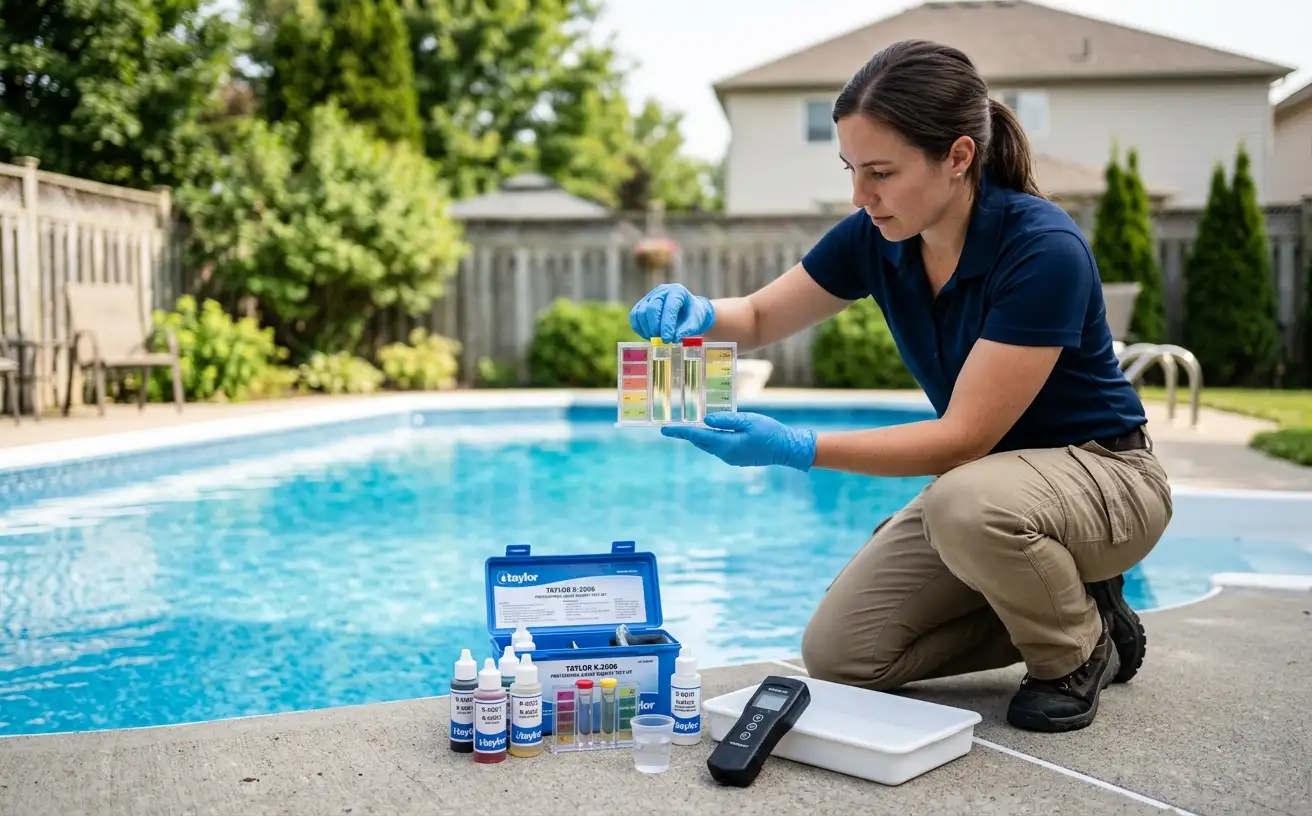
Weekly DIY test (test strips or kit)
Test free chlorine, pH, and alkalinity weekly. It takes about two minutes. Do it the same day each week, Saturday morning is a common choice, so your readings are consistent and comparable.
Monthly deep test
Once a month, add calcium hardness, cyanuric acid, and metals to your weekly parameters. This catches the slow-drifting issues that weekly testing misses.
Event-triggered testing
Test outside your schedule after heavy rain or a storm, a pool party with ten or more people, an extended heat wave, an algae bloom, cloudy water, or after adding significant chemicals. These events can shift your chemistry fast.
Seasonal professional testing
Get a professional water analysis at three points minimum: opening, mid-summer (July or August), and pre-closing. A professional ottawa pool opening establishes your baseline for the season, and pre-closing testing protects your water through winter. You can also bring a sample to ML’s retail store for free testing anytime.
Water Testing Methods Compared
Different methods suit different needs. Here’s how they stack up.
Test strips
The fastest and cheapest option. You dip the strip, wait, and compare it to a color chart. Accuracy depends on strip freshness and your eye for color-matching. They’re great for daily and weekly quick checks, though less precise for calcium hardness and stabilizer.
Liquid drop test kits
More accurate than strips. You add reagent drops to a water sample and count color changes. It takes longer and uses more consumables, but the results are reliable. This is the best choice for owners who want to manage their own chemistry precisely.
Digital testers
The highest accuracy for at-home testing. A digital reading eliminates color-matching guesswork. They cost more upfront and require calibration and batteries, but they’re ideal for salt pool owners who need consistent salt readings.
Professional water analysis (retail store)
The gold standard. ML’s free water testing at the Kinburn retail store uses professional-grade equipment for the most accurate readings, and the team recommends specific products based on your results. It’s the best option for troubleshooting, seasonal deep-tests, and any owner who wants real confidence in their numbers.
| Method | Accuracy | Cost | Best for | Ottawa fit |
|---|---|---|---|---|
| Test strips | Moderate | Lowest | Weekly quick checks | Everyday use |
| Liquid kits | High | Moderate | Precise DIY management | Hands-on owners |
| Digital testers | Highest (DIY) | Higher | Salt pools, salt readings | Salt pool owners |
| Professional analysis | Highest | Free at ML | Troubleshooting, deep-tests | Seasonal baselines |
Why Ottawa’s Climate Changes the Testing Rhythm
Our local conditions reshape how and when you test.
Spring pollen and algae pressure. The Ottawa Valley’s heavy spring pollen consumes chlorine rapidly, so expect to test chlorine twice weekly in May and early June, and to shock more often. Our companion guide on pool shock treatment covers exactly when and how to do it.
Summer UV intensity. Long, sunny Ottawa days deplete unstabilized chlorine within hours, making cyanuric acid critical for keeping chlorine active. Test stabilizer at least monthly through peak summer.
Ottawa Valley hard water. Municipal and well water in the region trends hard, pushing calcium hardness naturally toward the upper end of the target range. Regular calcium testing prevents scale before it forms, and issues like green pool water often trace back to chemistry that drifted unnoticed.
Fall closing chemistry. Pre-closing testing is one of the most important tests of the year. Balanced chemistry going under the cover prevents the staining, scaling, and algae problems that create expensive spring surprises. A thorough ottawa pool closing includes this step, and homeowners west of the city can book dedicated pool closing kanata service.
Short season, compressed testing. Ottawa’s swim season is roughly 4 to 5 months, so every testing rhythm above compresses into that window. Consistency matters even more here than in longer-season regions.
Common Water Testing Mistakes to Avoid
Watch out for these frequent errors:
- Testing in the shallow end near the return jets, where freshly cycled water isn’t representative
- Testing right after adding chemicals, before at least 30 minutes of circulation
- Using expired test strips, which lose accuracy about 6 months after opening
- Storing test kits in the pool shed, where heat and moisture degrade the reagents
- Testing chlorine but ignoring pH, when chlorine effectiveness depends on pH
- Adjusting pH before alkalinity, so the fix won’t hold
- Ignoring stabilizer because it “seems fine,” while silent buildup causes chlorine lock
- Skipping metals testing until staining appears, by which point it’s a bigger problem
Getting these fundamentals right is what separates a pool that stays clear all season from one that lurches from problem to problem.
When to Get a Professional Water Analysis
DIY testing has its limits. Reach out for a professional analysis when you face persistent cloudy or discolored water that testing can’t explain, unusual staining from metals or scale, chronic algae despite balanced test-strip readings, or suspected chlorine lock from stabilizer buildup that needs a precise cyanuric acid reading. Salt pool salt-level troubleshooting, seasonal deep-testing, and establishing a baseline for a brand-new pool are also ideal times to bring in the professionals.
You can bring a water sample to ML’s retail store for free testing, or hand the entire job off with a professional pool cleaning service plan that includes testing and treatment every visit.
Get Expert Help with Your Ottawa Pool Chemistry
Managing pool chemistry is far easier with local expertise. For more than 30 years, ML Pool Services has helped Ottawa Valley homeowners keep their water clean, balanced, and safe through every season. Our free retail store water testing is a genuine differentiator few local competitors match, giving you professional-grade readings and product recommendations at no cost. For owners who’d rather not manage any of it, our professional weekly pool maintenance handles testing and treatment every single visit.
If hidden water loss is throwing off your chemistry, professional pool leak detection can find the cause. Explore the full range of pool services we offer to keep your water perfectly balanced all season.
Ready to take the guesswork out of your pool chemistry? The team behind ottawa pool services at ML Pool Services is here to help. Contact us to get started with a free, no-pressure quote.