If you own a pool, you’ve almost certainly been told you need to “shock” it, probably without a clear explanation of what that actually means. Is shock the same as chlorine? When are you supposed to do it? How much do you use, and is there a wrong way to do it? For beginners especially, pool shocking is one of the most confusing parts of pool ownership, yet it’s also one of the most important for keeping your water clean, clear, and safe.
This guide covers the whole picture, from what shocking really is and how it differs from regular chlorine, through exactly when to do it and the step-by-step procedure. We’ll also cover Ottawa-specific timing for spring pollen, summer bather load, and pre-closing treatment. By the end, you’ll know precisely when to shock, what product to reach for, and how much to use for your pool.
Quick Answer: What Is Pool Shocking?
Pool shocking means adding a large, concentrated dose of chlorine (or a chlorine alternative) to your pool water to rapidly raise sanitizer levels, kill bacteria, break down organic contaminants, and eliminate chloramines. It differs from regular chlorine dosing because it’s a temporary spike, not maintenance-level sanitization. Ottawa pool owners typically shock at opening, after storms or heavy use, and before closing. Most residential pools need 1 pound of granular shock per 10,000 gallons for a standard shock, doubled for algae treatment.
| When to shock | Why | How much (per 10,000 gal) |
|---|---|---|
| Pool opening | Reset winter chemistry | 1 lb |
| After a storm | Replace diluted chlorine | 1 lb |
| After heavy use | Clear sweat, oils, bacteria | 1 lb |
| Algae or green water | Kill and clear algae | 2 to 3 lbs |
| Before closing | Prevent winter algae | 1 to 2 lbs |
Pool Shock vs. Chlorine: What’s the Difference?
This is the question that trips up almost every new pool owner: are chlorine and shock the same thing? The short answer is that in most cases, shock IS chlorine, just delivered at a much higher dose.
Regular chlorine maintains a steady sanitizer level, ideally between 1.0 and 3.0 ppm of free chlorine, which is the target range ML Pool Services recommends for safe, balanced water. This ongoing level continuously sanitizes your pool as you use it. Shock, by contrast, is typically the same chlorine-based chemical family applied at 5 to 10 times that concentration for a short, powerful burst.
The purposes are different. Chlorine sanitizes continuously, while shock resets the water, blasting through contaminants that regular chlorine can’t keep up with. There’s also a non-chlorine shock option, potassium monopersulfate (MPS), which oxidizes contaminants without adding chlorine and lets swimmers return much sooner. Stocking the right pool shock treatment products for your situation is the first step, and for salt pool owners, the right pool salt ottawa supply works alongside occasional shocking to keep chlorine generation steady.
When Should You Shock Your Pool?
Shocking isn’t a fixed-schedule chore so much as a response to specific situations. Here are the scenarios that call for it.
Pool opening (spring)
Ottawa’s opening window typically runs from late April to mid-May. Shocking at opening kills anything that survived the winter under your cover and establishes a clean chemistry baseline for the season. A professional ottawa pool opening includes this step as part of getting your water swim-ready. Homeowners in the south end can book pool opening barrhaven service to handle opening and initial shocking together.
After heavy rain or a storm
Rainwater dilutes your chlorine and washes organic contaminants into the pool. A significant storm often calls for a shock afterward to restore sanitizer levels. Ottawa’s heavy spring pollen surges fall into this same category, acting like a contamination event that overwhelms normal chlorine. Keeping your filter in top shape matters here too, and knowing how often should you clean your pool filter helps your system handle these loads.
After heavy bather load or a pool party
Every swimmer introduces sweat, sunscreen, oils, and bacteria. A busy ten-person afternoon can easily require shocking that evening to reset the water. This is a good time to have your water tested to confirm exactly what it needs.
When you see algae or green water
Visible algae calls for a heavier shock dose than routine treatment, typically two to three times the standard amount. If you’re actively battling green water, our guide on why is my green pool water walks through the full recovery process alongside shocking.
When you smell chlorine strongly
Here’s a myth worth busting: a strong chlorine smell doesn’t mean too much chlorine, it means too little free chlorine. That smell comes from chloramines, the spent compounds formed when chlorine binds with contaminants, and shocking breaks them down. This and other misconceptions are covered in our myths pool chemistry breakdown.
Before closing (fall)
Ottawa’s closing window runs from mid-September to mid-October. A pre-closing shock helps prevent algae from taking hold under your winter cover during the long off-season. A thorough ottawa pool closing includes this treatment, and homeowners west of the city can book dedicated pool closing kanata service. Pairing your closing with quality safety cover installation further protects your balanced water through winter.
Routine weekly or bi-weekly shocking
Proactive owners often shock on a light regular schedule to prevent problems before they start rather than reacting to them. If that sounds like more than you want to manage, professional weekly pool maintenance handles shocking and chemistry automatically as part of the service.
Types of Pool Shock (and Which to Choose)
Not all shock is the same. The three main types suit different situations, and choosing the right one matters.
Calcium hypochlorite (Cal Hypo)
The most powerful and fastest-acting option, Cal Hypo is also the most economical. It’s unstabilized, meaning it contains no cyanuric acid, which makes it ideal for algae blooms, opening, and heavy contamination. One important warning from ML’s product guidance: never use Calcium Hypochlorite tablets in an automatic chlorinator, as this can cause dangerous reactions.
Dichloroisocyanuric acid (Di-Chlor)
Di-Chlor is stabilized, containing cyanuric acid that protects the chlorine from UV breakdown. It’s gentler on vinyl liners and dissipates more slowly, making it a good choice for routine shocking throughout the season.
Non-chlorine shock (potassium monopersulfate / MPS)
This oxidizer clears contaminants without adding any chlorine, so swimmers can return in as little as 15 minutes. It’s ideal for post-party shocks when you want fast turnaround. The one limitation: it doesn’t kill algae, so pair it with a chlorine shock whenever algae is present.
| Shock type | Speed | Stabilized | Best for | Swim wait |
|---|---|---|---|---|
| Cal Hypo | Fastest | No | Algae, opening, heavy loads | 8 to 24 hrs |
| Di-Chlor | Moderate | Yes | Routine shocking | 8 to 24 hrs |
| Non-chlorine (MPS) | Fast | N/A | Post-party turnaround | 15 min |
How to Shock Your Pool: Step-by-Step
Done correctly, shocking is straightforward. Here’s the proper procedure from start to finish.
Step 1: Test your water first
Before anything else, test your pH, alkalinity, and current chlorine level. Shocking works best when pH sits between 7.2 and 7.6, ML’s recommended range. If your pH is off, adjust it before shocking, since shock is far less effective at high pH.
Step 2: Calculate your pool volume
You need to know your pool’s volume to dose correctly. For a rectangular pool, multiply length by width by average depth by 7.5 to get gallons. For a round pool, multiply diameter by diameter by average depth by 5.9. Getting this number right is the foundation of correct dosing.
Step 3: Choose your shock and calculate the dose
For a standard shock, use 1 pound of granular shock per 10,000 gallons. For algae treatment, increase to 2 to 3 pounds per 10,000 gallons. For a non-chlorine oxidizer, follow the package rate, usually around 1 pound per 10,000 gallons.
Step 4: Pre-dissolve if required
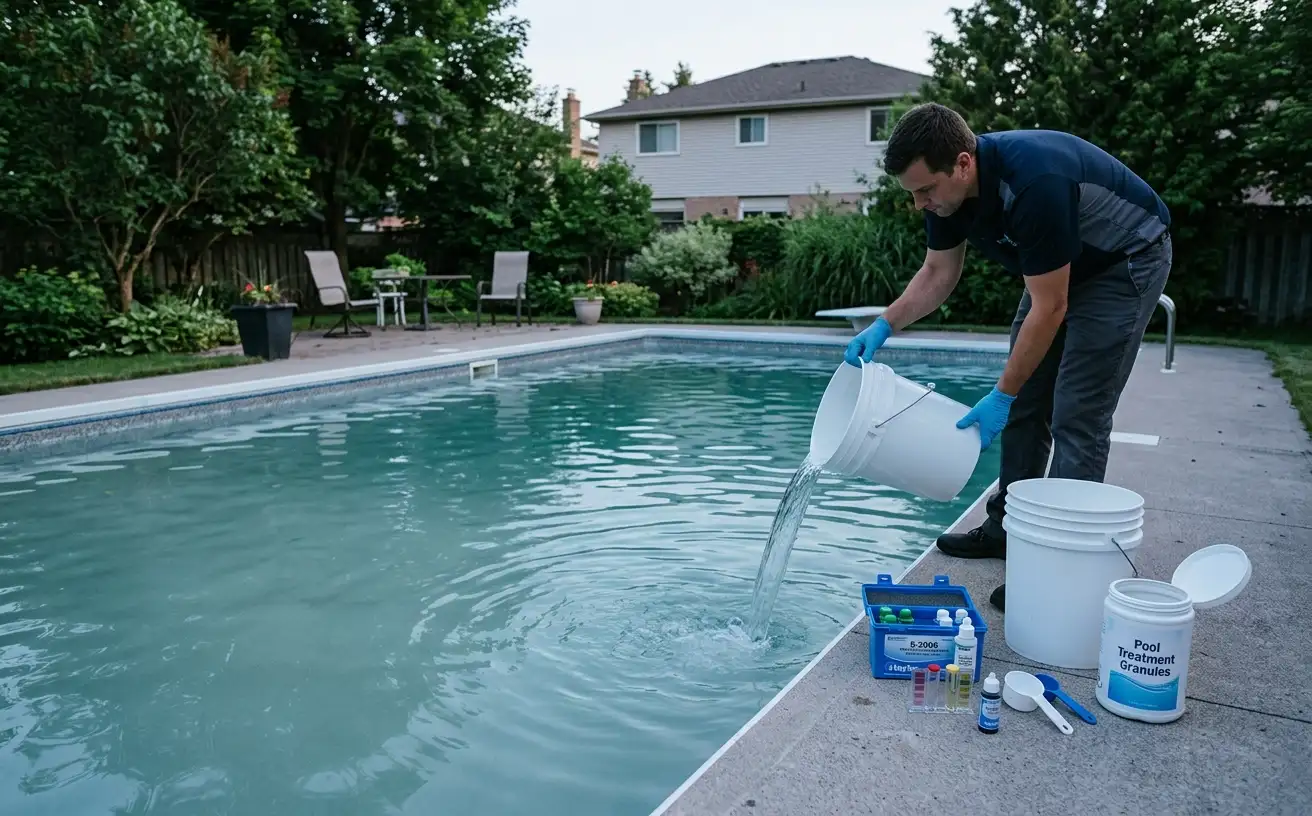
Cal Hypo and Di-Chlor should be pre-dissolved in a bucket of water before adding them, which protects vinyl liners from bleaching and spotting. Add the shock to the water, never water to the shock. Non-chlorine shock can typically be added directly to the pool.
Step 5: Add at dusk with the pump running
UV sunlight breaks down chlorine rapidly, so applying shock in the evening maximizes its effectiveness. Make sure your pump is running first, then add the dissolved shock so it distributes through the return jets. Proper circulation from healthy swimming pool pumps ensures the shock reaches every part of the pool.
Step 6: Let it circulate and retest
Run the pump for at least 8 hours, ideally overnight, to fully circulate the shock. Retest your chlorine level before allowing anyone back in the water.
Step 7: Wait until chlorine drops to safe levels
For chlorine shock, wait until levels fall below 4 ppm before swimming, usually 8 to 24 hours. For non-chlorine shock, the wait is just 15 minutes. Never let anyone swim while chlorine is still at shock concentration.
Should You Add Chlorine or Shock First?
This common question doesn’t have a single answer, since it depends on the scenario. For opening, shock first to reset your chemistry, then transition to regular chlorine maintenance once levels stabilize. For weekly maintenance, keep your chlorine at 1 to 3 ppm continuously and shock separately only when needed. For an algae bloom, balance your pH first, then shock, then let it circulate fully before resuming regular chlorine.
One rule is absolute: never add different chemicals to the pool at the same time, and never mix them in the same bucket. Combining pool chemicals can cause dangerous reactions. That’s a safety issue, not just a chemistry preference. Using a proper pool chemical feeders system for routine chlorine helps keep ongoing dosing separate and controlled.
Common Pool Shocking Mistakes to Avoid
Even experienced owners slip up. Watch out for these common errors:
- Shocking during the day, so UV wastes much of the chlorine
- Adding shock through the skimmer while a chlorine tablet sits in it, risking a dangerous reaction
- Not pre-dissolving Cal Hypo on vinyl-liner pools, causing bleach spots
- Assuming a strong chlorine smell means too much chlorine, when it means too little
- Skipping pH balance before shocking, which sharply reduces effectiveness
- Swimming before chlorine drops back to safe levels
- Under-dosing to save money, which fails to do the job and wastes product
How Ottawa’s Climate Affects Your Shocking Schedule
Our local conditions shape how often you’ll need to shock.
Spring pollen. Ottawa Valley pollen loads act like a contamination event, so expect to shock more often in May and early June than during the rest of the season.
Summer heat and UV. Long, sunny days deplete chlorine faster. Unstabilized shock like Cal Hypo needs cyanuric acid support during peak season to hold levels, and staying on top of pool water testing ottawa helps you catch depletion early.
Fall storms and leaves. October storms combined with heavy leaf debris often trigger a pre-closing shock even when your routine schedule wouldn’t call for one.
Hard water. The Ottawa Valley’s calcium hardness, which ML targets in the 150 to 280 ppm range, can cause Cal Hypo to cloud the water temporarily. It’s harmless and clears on its own, but it can look alarming. Persistent cloudiness or scale can also signal calcium buildup worth addressing separately. If cloudiness lingers with no clear chemical cause, professional pool leak detection can rule out other issues in your system.
When to Skip DIY and Get Professional Help
Shocking is manageable for most owners, but sometimes it’s worth calling in the professionals. Reach out for help if you’ve shocked multiple times and the water still isn’t clearing, if you’re unsure whether the problem is chemistry, filtration, or something else, or if you’re new to pool ownership and want an expert to establish your baseline chemistry.
You can also bring a water sample to ML’s retail store for free testing, which takes the guesswork out of exactly what your pool needs. For owners who’d rather not manage any of it, a full pool cleaning service plan puts your chemistry entirely in professional hands.
Get Expert Help Keeping Your Pool Balanced
Managing pool chemistry is far easier with local expertise on your side. For more than 30 years, ML Pool Services has helped Ottawa Valley homeowners keep their water clean, balanced, and swim-ready through every season. Our retail store offers free water testing so you always know exactly what your pool needs, and our professional maintenance plans take chemistry management off your plate entirely.
Explore the full range of pool services and pool products we offer to keep your pool crystal clear all summer long.
Ready to take the guesswork out of pool chemistry? The team behind ottawa pool services at ML Pool Services is here to help. Contact us to get started with a free, no-pressure quote.