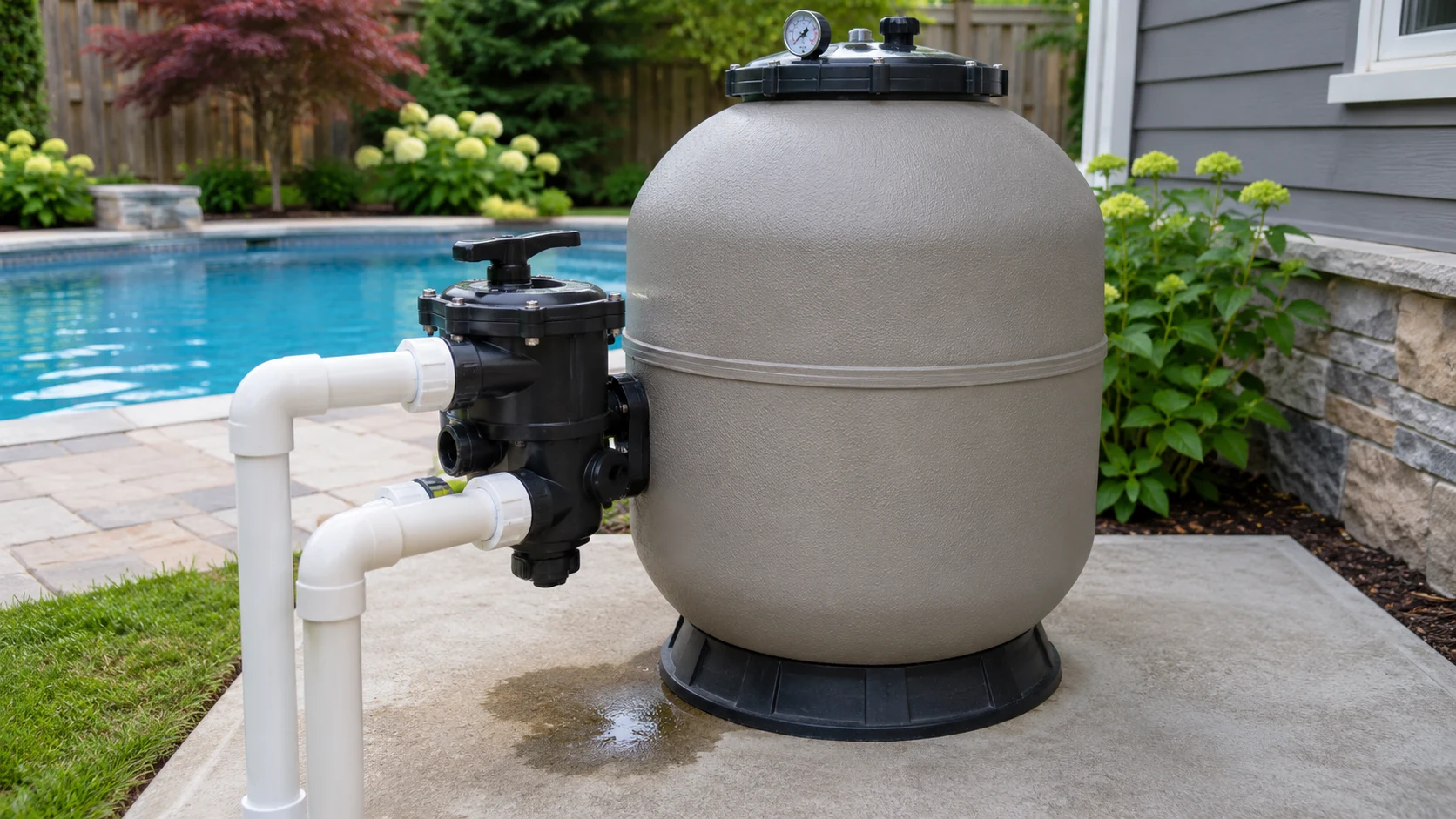
A damp patch beside your pool filter is a useful clue, but it is not a diagnosis. Water can travel down the tank or along a pipe before it reaches the pad, so the puddle may not sit directly beneath its source.
The most helpful thing an owner can do is describe where water first becomes visible and when it appears. This guide explains how to report those observations for pool filter repair or equipment assessment, without opening the filter or trying to adjust a pressurized assembly.
Before looking closer: leave the filter assembled
Do not loosen, tighten or remove a filter clamp, lid or connection while the system is operating or pressurized. Filters can contain stored pressure even after the pump stops. Follow the shutdown and pressure-relief instructions for the exact model, and have a qualified professional handle servicing if you are unfamiliar with those instructions.
If you see a damaged tank, a displaced clamp or forceful spraying, keep people away and seek professional advice. Do not restart the system simply to recreate the leak for a photograph. Only make observations from a safe position; a description is enough to begin the conversation.
Where do you first see water?
Use the areas below to describe the problem. Different filter designs have different components, so there may not be a direct match for every item on your equipment.
At a pipe connection beside the filter
Water appearing at an external connection can draw attention to that joint, but it may also have run down from somewhere above it. Describe which side of the filter is wet, whether you can see a drip forming and whether nearby pipework is wet too.
Do not assume that more tightening will solve it. The fitting type, alignment and condition all need to be considered. If the issue turns out to be in the adjacent plumbing, pool plumbing repair may be the relevant service rather than replacing the filter itself.
Around the lid or tank seam
A wet line around the closure is important to report precisely. Tell the service team whether the filter was recently opened or cleaned, and whether the moisture appeared immediately afterward or much later.
That history can help with assessment, but it does not prove that a seal alone is responsible. Keep the closure untouched until the equipment has been made safe and inspected. A visible leak around a pressure-containing part is not a reason to experiment with the clamp.
Near a gauge, relief fitting or valve
A small drip high on the assembly can leave a much larger wet area lower down. If you can safely see where a drop forms, describe that point rather than just saying “the bottom of the filter leaks.” Include a wider photo that identifies the component’s position.
Do not remove a gauge or turn an unfamiliar fitting to test your theory. Record any display or gauge reading you can already see, along with whether the pump was running when the moisture was first noticed.
At the base, or apparently through the tank
Water collecting at the base does not establish that the tank is cracked. It could have travelled there from above or from nearby equipment. Describe whether the tank surface is wet, whether the pad was already wet from rain and whether another component appears to be dripping.
If you can see a split, deformation or other damage, report it and avoid operating the equipment pending professional guidance. An improvised patch on a pressure vessel is not an appropriate substitute for an assessment.
Timing adds context to the location
Tell the service team when you first noticed the water. Useful details include whether it followed routine filter cleaning, spring opening, a plumbing change or a period of normal operation. Also mention whether the wet area was observed while the system was already running or after it had stopped.
You do not need to run a special test to collect this information. Report what you have already observed and let the technician decide what controlled checks are necessary.
For example, “water appeared around the upper seam after the filter was cleaned yesterday” is more useful than “I think the whole filter is broken.” It identifies a location and a sequence without jumping to a conclusion about the repair.
A leak is a different question from a dirty filter
Routine cleaning addresses accumulated material inside a filter. An external leak asks a separate question: why is water escaping where it should remain contained? Cleaning the filter more often is not, by itself, an explanation or a repair for that leak.
If your main concern is cleaning frequency rather than escaping water, the pool filter cleaning guide is the more relevant starting point. Use the manufacturer’s instructions for the model when deciding what maintenance is required.
Likewise, poor water clarity does not establish that the filter is leaking or needs replacement. Pool water analysis and an equipment assessment address different parts of that problem. Tell the team about both the water condition and any visible moisture so neither issue gets overlooked.
Send three useful photos, if you can take them safely
- The equipment area: show the filter and the surrounding pump, pipes and pad.
- The visible wet area: photograph it without reaching across the equipment or touching the leaking part.
- The model label: include enough detail to identify the filter, if the label is accessible.
Add when the leak began and any recent work. A photo can help identify the equipment and plan the assessment, but it cannot confirm the condition of a hidden seal or the integrity of the tank.
What happens after the leak is assessed?
Ask the technician to explain which component is affected, whether the surrounding assembly is serviceable and what the proposed work includes. ML’s equipment service page specifically offers help identifying what can be repaired and what needs replacement.
If a new unit is recommended, ask why and how it will suit the existing circulation system. You can review ML’s pool filter options and the comparison of sand, cartridge and DE filters once replacement is a supported decision. A puddle alone is not enough information to choose a new filter.
Contact ML Pool Services about a leaking pool filter
Call 613-832-3893 with the model, the visible leak location and any recent maintenance details.